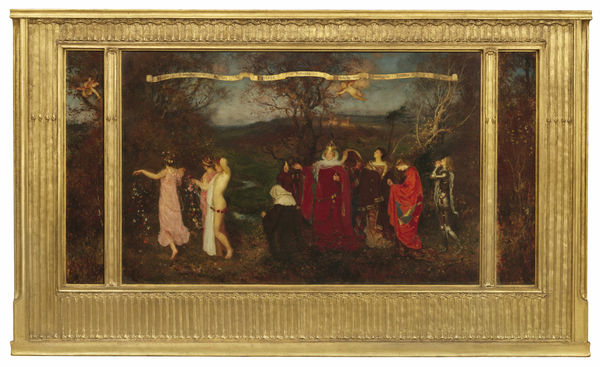
Dorothy Webster Hawksley (1884-1970)
And the daughter of Pharaoh came down to wash herself at the river / and when she saw the ark among the flags, she sent her maid to fetch it'
John Russell Taylor, art critic
This loose but atmospheric picture is a sketch for a larger, highly finished, almost enamelled painting, done on panel. Both, in their very different ways, convey a magical sense of dancing otherness, so eloquently evoked by Ariel's song in Act I Scene II of Shakespeare's The Tempest:
Come unto these yellow sands, And then take hands. Curtsied when you have, and kissed The wild waves whist. Foot it featly here and there, And sweet sprites bear The burden. Hark, hark!
An interesting difference may be noted between the sketch and the finished picture, in the sky: in the sketch the stars are identifiable as the constellation of Cassiopeia, a vain queen of Aethiopia in Greek mythology said to have been tied to her throne as punishment for boasting she was more beautiful than the sea nymphs. In the finished painting the stars are randomly distributed.
Huskisson's composition clearly owes a great deal to Richard Dadd's earlier painting of the same title, the last he exhibited before he went mad, which was shown at the Royal Academy exhibition of 1842. In the catalogue to the Victorian Fairy Paintings Exhibition at the RA in 1997, Jeremy Maas compared both pictures:
Somehow it [the Dadd] is strangely disturbing. Dadd's sprites look like tormented souls being herded into a bath-house. Huskisson, on the other hand, matches Shakespeare's poetry with an exquisite lyricism of his own, with sea-nymphs holding hands and dancing in the early evening air, while a group of white marble-limbed nymphs luxuriate and cavort against a darkening sky. Rarely can the shards of twilight blue have been so delicately rendered. Even the lapidary figures in the proscenium arch are in perfect harmony with the scene.
These figures are identifiable as characters from The Tempest: Prospero, Caliban, Ariel, Ferdinand and Miranda. Benjamin Wyatt, who designed the new Drury Lane Theatre of 1811, was insistent that a proscenium arch, however decorated, would not distract from the stage any more than the contemplation of a picture would be diverted 'from the richness … of a picture frame'. Two other features of our picture also owe something to the London stage. First, the distinctive lighting by the use of limelight (or 'koniaphostic' light, produced by burning quicklime in a hydrogen/oxygen flame), first used in 1837 at the Covent Garden Theatre. Secondly, the ethereal poise of the sprites to the ballet dancer Madame Taglione, who, in productions of La Sylphide in the 1830s, created for the first time the illusion of floating across the stage by moving en pointe in a calf-length tutu.
Our painting was commissioned in 1847 by Samuel Carter Hall, the editor of the Art Union magazine, later the Art Journal, an unlikeable but irrepressible fellow said to have been the inspiration for Dickens's unctuous Mr Pecksniff. Huskisson, like many of the best fairy painters, was relatively unknown. He came from humble origins in Nottingham, led rather an obscure life, and then, as Hall put it, 'slipped out of the world, no-one knew when or how'. The painter Frith, perhaps fooled by the artist's broad Midlands accent, found Huskisson uncouth and uneducated, and recalled Lord Northwick calling out: 'Mr Huskisson, was it not a picture dealer who bought your last fairy picture?' — 'No, my Lord! No, my Lord! It were a gent!' he replied.