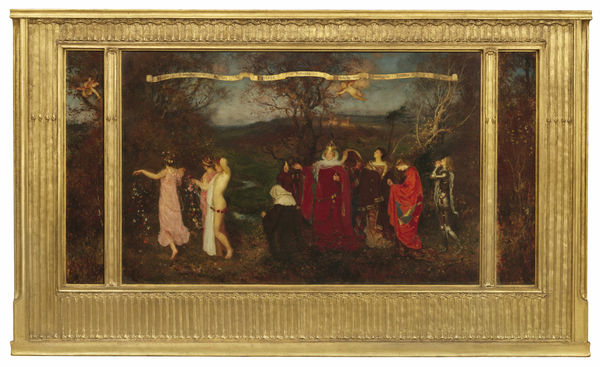
Dorothy Webster Hawksley (1884-1970)
And the daughter of Pharaoh came down to wash herself at the river / and when she saw the ark among the flags, she sent her maid to fetch it'
Christie's,'Important Victorian Pictures, Drawings and Watercolours', 4 June 1982;
Private collection, Italy
New Gallery, 1898
Woodbury Gallery, New Bond St, 1902
Pictures of the Year, 1898, ill p 115
Jewish Chronicle, 11 July 1902, issue 1736, p 20
St James's Gazette, 18 July 1902, p 18
Maud Beddington, NOTES by Maud Beddington about Sir Edward Burne-Jones and his Art, p 5 (Tate Archive)
Maud Beddington was a pupil of Burne-Jones, whom her mother had known from Birmingham, where their families were neighbours. Maud's father was Maurice Moses, who changed his name to Beddington in 1868, having amassed a fortune in the clothing trade. He left £1m in his estate. When Maud died, a wealthy woman, she left several Burne-Joneses to the Tate, including Vespertina Quies (1893), which she had witnessed being painted.
Both Maud's father and Burne-Jones died in 1898, the year that this painting was first exhibited at the New Gallery. Beddington had been encouraged to show the painting in public by Burne-Jones, as she remembered in a privately published pamphlet entitled NOTES by Maud Beddington about Sir Edward Burne-Jones and his Art:
Once when I told him I should like to exhibit my picture "Sleep" at the New Gallery, I said "I think my mother would like me to". He looked straight in front of him, quite angry—not with me but with the fact that I had said that. He knew, as I did, that I wanted it myself—and he would have thought it quite natural for me to want it. It was a great lesson to me—I don't think I have ever been deceitful in that way since! (Or hardly ever.)
Indeed she was not 'deceitful in that way', for four years later in 1902 she had a one-woman show at the Woodbury Gallery, in which she showed ten oils and fifty watercolours. It was noticed (in The Jewish Chronicle) that her work was divided into two kinds: watercolours of children, which were similar to the quiet contemplative pictures of Cayley Robinson, and her oils 'of a highly imaginative nature and breathing perhaps something of the expressive spirit which Miss Beddington may have involuntarily acquired from Sir E. Burne-Jones'. The review continues:
'Sleep' is shown in the person of a young girl lying asleep on the edge of a cliff, with head thrown back: three figures holding poppies significant of slumber, stand before her, and behind come a long array of spirit figures with floating hair, each one bringing a trail of suggestive poppies.
Several of the other paintings were accompanied by passages from Dante, Shelley, the scriptures and Matthew Arnold. These pictures and the texts suggest that Beddington, along with other artists of the time, was influenced by one of the many offshoots of Theosophy, giving vague meaning to our shadowy picture: the floating figures are a procession of souls from beyond the veil bringing the gift of sleep in the form of poppies to a fallen figure on the left who will join them.