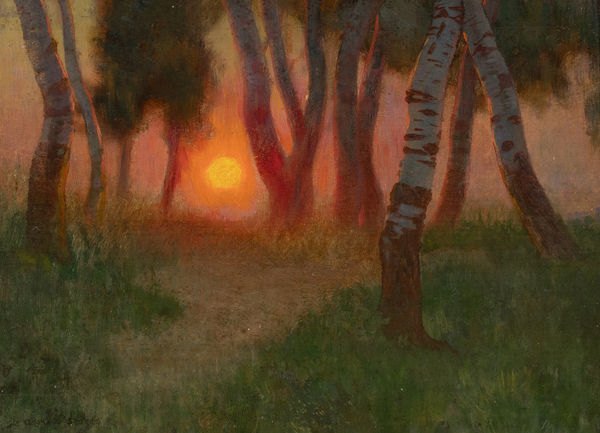
Michael Howd, (fl. 1940-1946)
Exhibitions
Royal Academy, 1946, no. 811
An American from the Southwest, Howd went to art school, 'not that you learnt much there', and earned enough money as a taxi driver to go 'straight to Paris, where I was taught nothing'. There, he resolved on 'two facts: one was that tempera was the only medium for me, the other that I did not belong in Europe', he wrote in a pithy chapter My Tempera Teaching for his friend Maxwell Armfield's book (Tempera Painting Today, 1946). In London, he was influenced by the tempera painters Batten and Armstrong, Hodgkin and Armfield, all of whom he had sought out once he'd 'spotted [them] … hidden away in the corners in the Academy like cactus flowers in the scrub'. He learnt, too, from Joseph Southall, who 'showed me how to paint a blue – which as I say is not the color the sky ever is in the daytime anywhere I know of; but is the only way it feels anywhere where there's sun about.'
Leaving Europe behind, he seems to have travelled extensively (far further than his savings from driving taxis could have taken him) looking carefully at pictures: to India and to the Far East, China and Japan. Returning to America, Howd enrolled on Jay Hambidge's 'Dynamic Symmetry' course in New York, until 1924 when Hambidge died and Howd went back home to 'look at the foothills and desert'. He had probably been egged on to attend the course by Armfield who had taken it five years before, with his wife Constance. In 1940, Armfield and Howd were together at La Jolla (just north of San Diego), where Howd gave Armfield his painting Pacific Pattern, showing the spectacular seaside house on the cliffs where they stayed. That picture is illustrated in Tempera Painting Today, and it was in Armfield's studio when he died. Howd's device — already similar to his friend's — has since been doctored to look more like Armfield's own priapic monogram, and it is now in Southampton Art Gallery where it has been ascribed to Armfield. Howd's device is ingenious: In Scotland, the word 'Howd' means to move from side to side, or up and down, or sway in a rocking motion, and the double headed snake symbol (an amphisbaena, meaning 'to go both ways') below his monogram is indicative of this motion.
In 1942, one of Howd's pictures was sent in for exhibition at the RA from West Wycombe, near to where Armfield lived, and in 1946, our picture, and another, were sent in from an address next door to Armfield's in Blackheath. This was the year that the Royal Society of Painters in Water-Colours asked Howd to contribute to their important Tempera Paintings exhibition, but 'his only three pictures available in Europe were already earmarked to be sent to the Academy', according to Armfield. Howd wrote that in California, the tempera painter has to adjust to the climate:
… your gesso would not half of it stand the heat. We use rabbit-skin glue as tough as iron, and that is all needed in this climate. … and have to use pulp-board or something that will not crack up with the heat. … One thing I found in the blaze of the West, where you just cannot see color or anything else outdoors most of the time - only feel it - and that is: egg does something to colors that nothing else does. … My point is that it really is true that under-colors do a job we painters still neglect. I saw the glass in Chartres (maybe some of it is still there) and I said to myself: I can do that with egg, up to a point, and I do not rest till I do it. So I am not taking a vacation at present. No, siree. The point is that egg is almost as transparent as colored glass, and the gesso around does act as the outside light to a window.
-
 William Joseph Julius Caesar Bond (1833-1926)A Rustic Bridge on a Sunny Day£1,800
 -
Adrian Scott Stokes (1854-1935)Sunset in a Wooded LandscapeSold
-
John Clayton Adams (1840-1906)Evening Reflection
-
Charles Green (1840-1898)Bruges£3,800
-
Eleanor Fortescue-Brickdale (1872-1945)Una and the Red Cross Knight
-
George Sherwood Hunter (1846-1919)The Lasting Snow
-
Samuel Lucas (1805-1870)Goldfinches amongst ThistlesSold
-
John Frederick Tennant (1796-1872)Red Hill, Surrey£6,500
-
Sir Charles Lock Eastlake (1793-1865)A Mountainous Landscape£8,500
-
Edward Reginald Frampton (1872-1923)Hills of the Land and Sky: Cumberland